Java Primitive Data Types
Data types are the foundation of any programming language. They tell the compiler what kind of data a variable holds—whether it's a number, a character, or a true/false value. Java has 8 primitive data types that act as the building blocks for data manipulation.
The 8 Primitive Data Types
Java is a strongly-typed language, meaning every variable must have a declared type. The 8 primitive types are categorized into four groups:
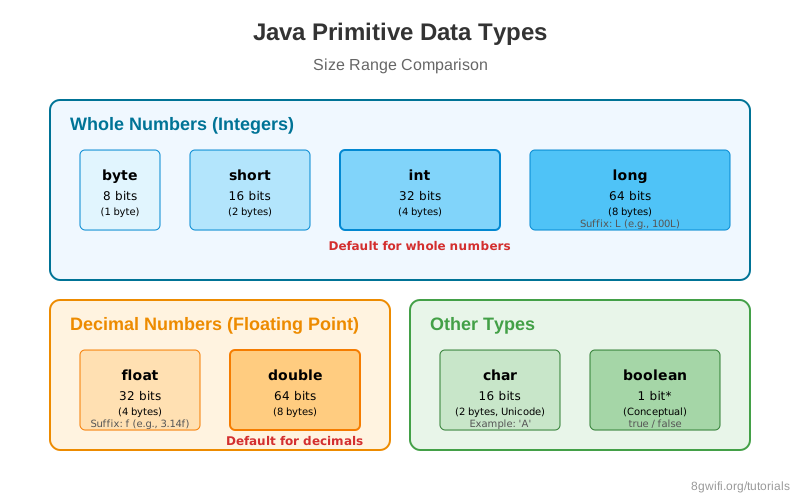
| Type | Group | Size | Description |
|---|---|---|---|
byte |
Integer | 1 byte | Very small logical numbers (-128 to 127) |
short |
Integer | 2 bytes | Small numbers (-32,768 to 32,767) |
int |
Integer | 4 bytes | Standard integer (default for whole numbers) |
long |
Integer | 8 bytes | Large integers (requires 'L' suffix) |
float |
Floating Point | 4 bytes | Decimal numbers (requires 'f' suffix) |
double |
Floating Point | 8 bytes | Precise decimals (default for decimals) |
boolean |
Other | 1 bit* | True or false values |
char |
Other | 2 bytes | Single character (Unicode) |
* The size of boolean is not precisely defined by the JVM specification, but conceptually represents 1 bit of information.
Integer Types (Whole Numbers)
Integer types store whole numbers without decimals. Use int for most
counting needs. Use long when int isn't big enough.
Click Run to execute your code
long variable,
you MUST append an 'L' or 'l' to the number if it exceeds the range of
int. Otherwise, the compiler treats it as an integer and throws an
error if it's too large.
long bigNum = 10000000000L; // Correct
Floating Point Types (Decimals)
Floating point types store numbers with fractional parts. double is
the default choice for modern applications as it's more precise than
float.
- float: Single precision (6-7 significant decimal digits).
Suffix 'f' required (e.g.,
3.14f). - double: Double precision (15-16 significant decimal digits). No suffix needed.
Financial Calculations
Never use float or double for currency! Floating-point
arithmetic can have rounding errors (e.g., 0.1 + 0.2 might equal
0.30000000000000004). For precise calculations like money, use the
BigDecimal class.
Boolean & Character Types
Boolean
The boolean data type has only two possible values:
true or false. It's essential for logic and decision
making.
boolean isActive = true;
boolean isGameOver = false;
Char
The char data type stores a single 16-bit Unicode character. It must
be enclosed in single quotes ' '.
char grade = 'A';
char symbol = '$';
Size & Range Demonstration
Let's use Java's wrapper classes to inspect the minimum and maximum values for each numeric type.
Click Run to execute your code
Summary
- int is the go-to type for whole numbers.
- double is the default for decimal numbers.
- boolean stores simply true or false.
- char stores a single character using single quotes.
- Remember suffixes: L for long literals, f for float literals.
What's Next?
Now that you know the available types, you need to learn how to store them! In the next lesson, we'll dive deep into Variables—how to declare, initialize, and name them correctly.
Enjoying these tutorials?