Java LinkedList
The LinkedList class implements both List
and Deque interfaces, making it versatile for lists, stacks, and queues.
It uses a doubly-linked list structure internally.
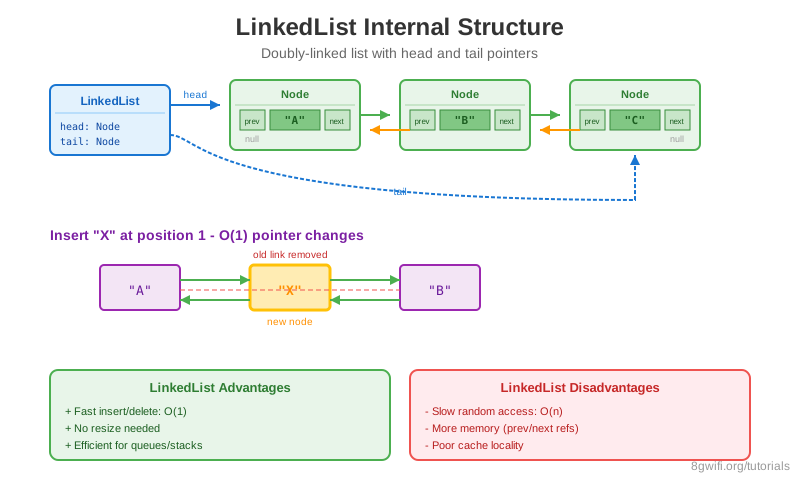
How LinkedList Works
Each element is stored in a Node that contains:
- The actual data (element)
- A reference to the previous node
- A reference to the next node
// Internal Node structure (simplified)
private static class Node<E> {
    E item;
    Node<E> next;
    Node<E> prev;
}
ArrayList vs. LinkedList
| Operation | ArrayList | LinkedList | Winner |
|---|---|---|---|
| get(index) | O(1) - Direct access | O(n) - Must traverse | ArrayList |
| add(element) | O(1) amortized | O(1) | Tie |
| add(0, element) | O(n) - Shift all | O(1) | LinkedList |
| remove(0) | O(n) - Shift all | O(1) | LinkedList |
| Memory | Compact array | Extra node overhead | ArrayList |
| Iterator remove | O(n) | O(1) | LinkedList |
When to Use LinkedList:
- Frequent insertions/deletions at beginning or middle
- Implementing a Queue (FIFO) or Stack (LIFO)
- You iterate and remove elements frequently
- You don't need random access by index
Creating a LinkedList
import java.util.LinkedList;
import java.util.List;
import java.util.Deque;

// As a List
List<String> list = new LinkedList<>();

// As a Deque (Double-ended queue)
Deque<String> deque = new LinkedList<>();

// Direct type (for LinkedList-specific methods)
LinkedList<String> linkedList = new LinkedList<>();
Deque Methods (Double-Ended Queue)
LinkedList implements Deque, providing powerful head/tail operations:
| Operation | First Element | Last Element |
|---|---|---|
| Add | addFirst(e) |
addLast(e) |
| Remove | removeFirst() |
removeLast() |
| Get | getFirst() |
getLast() |
| Peek (no exception) | peekFirst() |
peekLast() |
| Poll (no exception) | pollFirst() |
pollLast() |
Output
Click Run to execute your code
Using LinkedList as Stack and Queue
LinkedList<String> stack = new LinkedList<>();

// Stack operations (LIFO - Last In First Out)
stack.push("First");    // Same as addFirst()
stack.push("Second");
stack.push("Third");
String top = stack.pop();  // "Third" - removeFirst()
String peek = stack.peek(); // "Second" - peekFirst()

// Queue operations (FIFO - First In First Out)
LinkedList<String> queue = new LinkedList<>();
queue.offer("First");   // Same as addLast()
queue.offer("Second");
queue.offer("Third");
String first = queue.poll(); // "First" - pollFirst()
String next = queue.peek();  // "Second" - peekFirst()
Efficient Iteration
LinkedList<String> list = new LinkedList<>();
list.addAll(Arrays.asList("A", "B", "C", "D", "E"));

// Good: Using Iterator (O(n) total)
Iterator<String> it = list.iterator();
while (it.hasNext()) {
    System.out.println(it.next());
}

// Good: For-each loop
for (String s : list) {
    System.out.println(s);
}

// BAD: Using get(i) - O(n²) total!
// Each get(i) traverses from head
for (int i = 0; i < list.size(); i++) {
    System.out.println(list.get(i)); // Slow!
}

// Good: Descending Iterator
Iterator<String> descIt = list.descendingIterator();
while (descIt.hasNext()) {
    System.out.println(descIt.next()); // E, D, C, B, A
}
Performance Warning: Never use
get(i) in a loop
with LinkedList! Each call is O(n), making the loop O(n²). Use an Iterator instead.
Summary
- LinkedList uses doubly-linked nodes - O(1) insert/delete at ends
- Implements both
ListandDequeinterfaces - Best for: Stack/Queue operations, frequent insert/delete
- Avoid for: Random access by index (use ArrayList instead)
- Always iterate with Iterator or for-each, never with get(i)
Enjoying these tutorials?