Logical Operators
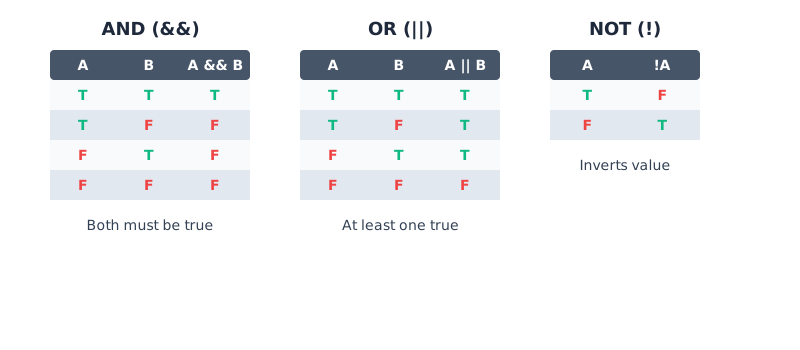
Logical operators allow you to combine multiple boolean expressions. They are essential for creating complex conditions in your programs, like checking if a user is logged in AND has administrative privileges.
The 3 Logical Operators
| Operator | Name | Description | Example |
|---|---|---|---|
&& |
Logical AND | Returns true if both operands are
true. |
(5 > 3) && (8 > 5) → true |
|| |
Logical OR | Returns true if at least one operand
is true. |
(5 > 3) || (5 < 3) → true |
! |
Logical NOT | Reverses the boolean state. | !(5 > 3) → false |
Click Run to execute your code
Short-Circuit Evaluation
Java's logical operators are "short-circuiting." This means they stop evaluating as soon as the result is determined.
- AND (&&): If the first operand is
false, the result MUST befalse. Java won't even evaluate the second operand. - OR (||): If the first operand is
true, the result MUST betrue. Java won't evaluate the second operand.
Why Short-Circuiting Matters
Consider this code:
if (object != null && object.callMethod()) { ... }If object is null, the first check fails (false). Because of
short-circuiting, Java never executes
object.callMethod(). If it didn't verify the first part, this
code would crash with a NullPointerException!
If you used a single & (bitwise AND), both sides would run,
causing a crash.
Summary
&&(AND): True only if ALL are true.||(OR): True if ANY are true.!(NOT): Flips true to false, and vice versa.- Logical operators
&&and||short-circuit: they stop evaluation early if possible, which improves performance and safety.
Enjoying these tutorials?