Interfaces in Java
An interface in Java is a reference type that defines a contract - a set of methods that implementing classes must provide. Interfaces enable multiple inheritance of behavior and are fundamental to Java's polymorphism.
What is an Interface?
An interface is like a completely abstract class. It defines what a class can do, not how it does it.
// Define an interface
interface Drawable {
    void draw();  // Abstract by default
}

// Implement the interface
class Circle implements Drawable {
    @Override
    public void draw() {
        System.out.println("Drawing a circle");
    }
}- Declared with
interfacekeyword - Methods are
public abstractby default - Variables are
public static finalby default (constants) - Cannot be instantiated
- Classes use
implementskeyword
Implementing Interfaces
A class implements an interface using the implements keyword and must provide implementations for ALL abstract methods.
interface Animal {
    void makeSound();
    void move();
}

class Dog implements Animal {
    @Override
    public void makeSound() {
        System.out.println("Woof!");
    }

    @Override
    public void move() {
        System.out.println("Dog runs");
    }
}
Multiple Inheritance via Interfaces
Unlike classes, a class can implement multiple interfaces. This is Java's way of achieving multiple inheritance.
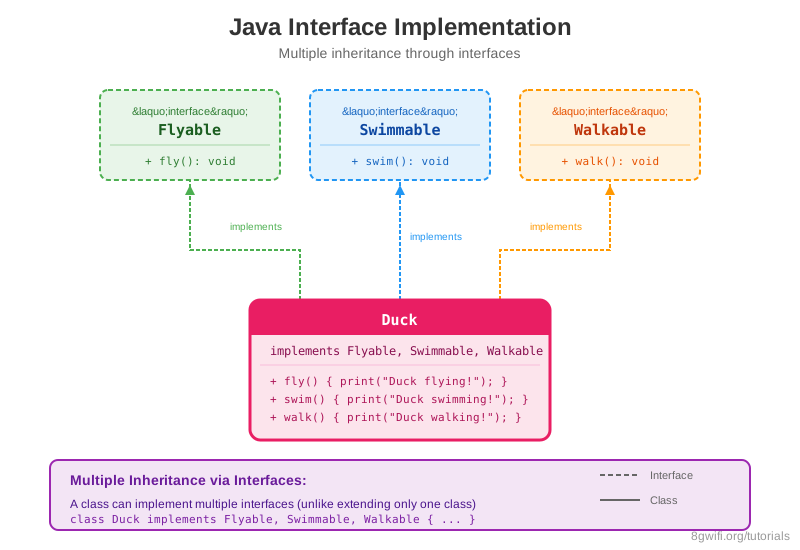
interface Flyable {
    void fly();
}

interface Swimmable {
    void swim();
}

interface Walkable {
    void walk();
}

// Duck can do all three!
class Duck implements Flyable, Swimmable, Walkable {
    @Override
    public void fly() {
        System.out.println("Duck is flying");
    }

    @Override
    public void swim() {
        System.out.println("Duck is swimming");
    }

    @Override
    public void walk() {
        System.out.println("Duck is walking");
    }
}
Default Methods (Java 8+)
Since Java 8, interfaces can have methods with default implementations. This allows adding new methods to interfaces without breaking existing implementations.
interface Vehicle {
    void start();
    void stop();

    // Default method - provides implementation
    default void honk() {
        System.out.println("Beep beep!");
    }
}

class Car implements Vehicle {
    @Override
    public void start() {
        System.out.println("Car starting");
    }

    @Override
    public void stop() {
        System.out.println("Car stopping");
    }

    // honk() is inherited, but can be overridden
}Static Methods in Interfaces (Java 8+)
Interfaces can also have static methods. These are utility methods related to the interface.
interface MathOperations {
    int calculate(int a, int b);

    // Static utility method
    static int add(int a, int b) {
        return a + b;
    }

    static int multiply(int a, int b) {
        return a * b;
    }
}

// Call static methods using interface name
int sum = MathOperations.add(5, 3);  // 8
Private Methods (Java 9+)
Java 9 added private methods to interfaces, allowing code reuse within default methods.
interface Logger {
    default void logInfo(String message) {
        log("INFO", message);
    }

    default void logError(String message) {
        log("ERROR", message);
    }

    // Private helper method (Java 9+)
    private void log(String level, String message) {
        System.out.println("[" + level + "] " + message);
    }
}
Click Run to execute your code
Constants in Interfaces
Variables declared in interfaces are implicitly public static final:
interface GameConstants {
    int MAX_PLAYERS = 4;        // public static final
    int MIN_PLAYERS = 2;        // public static final
    String GAME_NAME = "Chess"; // public static final
}

// Access as constants
System.out.println(GameConstants.MAX_PLAYERS);  // 4
Extending Interfaces
Interfaces can extend other interfaces using extends. An interface can extend multiple interfaces.
interface Readable {
    void read();
}

interface Writable {
    void write();
}

// Interface extending multiple interfaces
interface ReadWritable extends Readable, Writable {
    void readWrite();  // Additional method
}

class File implements ReadWritable {
    @Override
    public void read() { System.out.println("Reading"); }

    @Override
    public void write() { System.out.println("Writing"); }

    @Override
    public void readWrite() { System.out.println("Read and Write"); }
}
Functional Interfaces
A functional interface has exactly one abstract method. It can be used with lambda expressions.
@FunctionalInterface
interface Calculator {
    int calculate(int a, int b);  // Single abstract method
}

// Using lambda expression
Calculator add = (a, b) -> a + b;
Calculator multiply = (a, b) -> a * b;

System.out.println(add.calculate(5, 3));      // 8
System.out.println(multiply.calculate(5, 3)); // 15
Common Mistakes
- Forgetting public on implemented methods: Interface methods are public, so implementations must also be public
- Trying to instantiate an interface:
new Drawable()is invalid (use anonymous classes or lambdas instead) - Conflicting default methods: When implementing two interfaces with the same default method, you must override it
- Adding instance variables: Interfaces can only have constants (static final)
Summary
- Interfaces define contracts using
interfacekeyword - Classes implement interfaces with
implementskeyword - A class can implement multiple interfaces (multiple inheritance)
- Default methods (Java 8+) provide default implementations
- Static methods (Java 8+) provide utility methods
- Variables in interfaces are constants (
public static final) - Functional interfaces have one abstract method (for lambdas)
Enjoying these tutorials?