PHP Data Types
PHP supports 10 different data types, each designed for specific kinds of information. Understanding data types is crucial for writing efficient and bug-free code. Let's explore each type and learn when to use them!
PHP Data Types Overview
PHP organizes its data types into three categories:
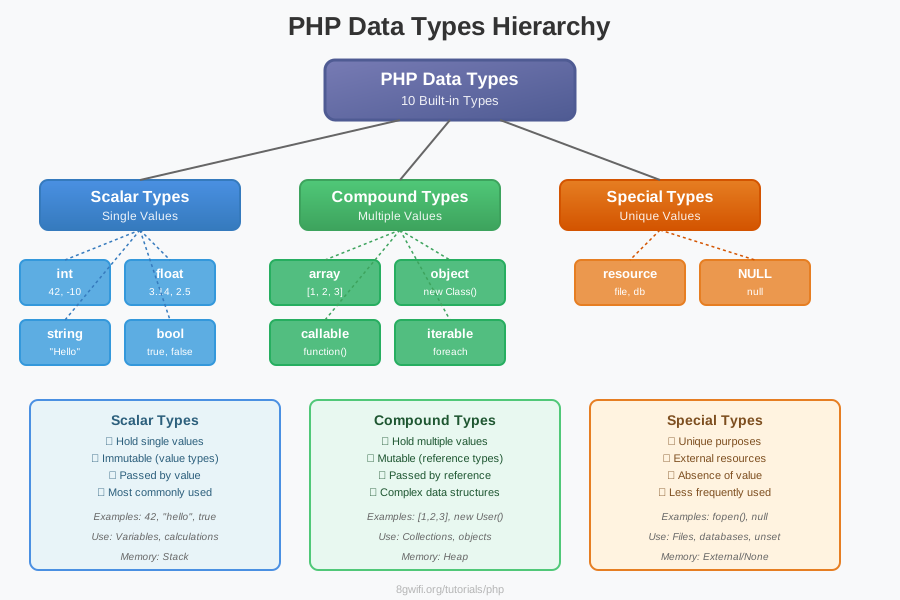
| Category | Types | Description |
|---|---|---|
| Scalar | int, float, string, bool | Single values |
| Compound | array, object, callable, iterable | Multiple values |
| Special | resource, NULL | Unique purposes |
Click Run to execute your code
Scalar Types (Single Values)
1. Integer (int)
Whole numbers without decimal points, positive or negative:
<?php
$age = 25;           // Positive integer
$temperature = -10;  // Negative integer
$hex = 0xFF;         // Hexadecimal (255)
$octal = 0755;       // Octal (493)
$binary = 0b1010;    // Binary (10)
?>| Platform | Range |
|---|---|
| 32-bit | -2,147,483,648 to 2,147,483,647 |
| 64-bit | -9,223,372,036,854,775,808 to 9,223,372,036,854,775,807 |
2. Float (double)
Numbers with decimal points or in exponential form:
<?php
$price = 19.99;
$pi = 3.14159;
$scientific = 1.5e3;  // 1500
$negative = -2.5;
?>==. Use a small
tolerance instead!
3. String
Sequence of characters enclosed in quotes:
<?php
$single = 'Single quotes';
$double = "Double quotes";
$name = "John";
$greeting = "Hello, $name!";  // Variable parsing
?>
4. Boolean (bool)
Represents true or false:
<?php
$isActive = true;
$isDeleted = false;

// These values are considered false:
// false, 0, 0.0, "", "0", [], null

// Everything else is true
?>
Compound Types (Multiple Values)
5. Array
Ordered collection of values:
<?php
// Indexed array
$colors = ["red", "green", "blue"];

// Associative array
$person = [
    "name" => "John",
    "age" => 30,
    "city" => "New York"
];

// Mixed array
$mixed = [1, "text", true, [1, 2, 3]];
?>
6. Object
Instances of classes:
<?php
class Person {
    public $name;
    public $age;
}

$user = new Person();
$user->name = "John";
$user->age = 30;
?>
7. Callable
Functions that can be called:
<?php
function greet($name) {
    return "Hello, $name!";
}

$callback = 'greet';
echo $callback("John");  // Calls greet("John")
?>
8. Iterable
Arrays or objects that can be iterated (PHP 7.1+):
<?php
function process(iterable $items) {
    foreach ($items as $item) {
        echo $item;
    }
}

process([1, 2, 3]);  // Works with arrays
?>
Special Types
9. Resource
References to external resources (files, databases):
<?php
$file = fopen("data.txt", "r");  // File resource
// $db = mysqli_connect(...);    // Database resource
fclose($file);
?>
10. NULL
Represents a variable with no value:
<?php
$empty = null;
$undefined;  // Also NULL

// These create NULL:
$var = null;
unset($var);
$notSet;
?>
Type Checking Functions
PHP provides functions to check variable types:
| Function | Checks For | Example |
|---|---|---|
is_int() |
Integer | is_int(42) → true |
is_float() |
Float | is_float(3.14) → true |
is_string() |
String | is_string("hi") → true |
is_bool() |
Boolean | is_bool(true) → true |
is_array() |
Array | is_array([1,2]) → true |
is_object() |
Object | is_object($obj) → true |
is_null() |
NULL | is_null(null) → true |
is_resource() |
Resource | is_resource($file) → true |
<?php
$age = 25;

if (is_int($age)) {
    echo "Age is an integer";
}

// Get type as string
echo gettype($age);  // Output: "integer"
?>
Common Mistakes
1. Comparing floats with ==
<?php
$a = 0.1 + 0.2;
$b = 0.3;

if ($a == $b) {  // ❌ May fail due to precision
    echo "Equal";
}

// ✅ Correct way
if (abs($a - $b) < 0.0001) {
    echo "Equal (within tolerance)";
}
?>
2. Confusing "0" and 0
<?php
$str = "0";
$num = 0;

if ($str == $num) {  // ✅ true (type juggling)
    echo "Equal with ==";
}

if ($str === $num) {  // ❌ false (different types)
    echo "This won't print";
}
?>
Summary
- 10 Types: int, float, string, bool, array, object, callable, iterable, resource, NULL
- Scalar: Single values (int, float, string, bool)
- Compound: Multiple values (array, object, callable, iterable)
- Special: Unique purposes (resource, NULL)
- var_dump(): Shows type and value
- gettype(): Returns type as string
- is_*(): Functions to check specific types
- Flexible: Variables can change types
What's Next?
Now that you know PHP's data types, let's explore Type Juggling - PHP's automatic type conversion system. You'll learn how PHP converts between types and when to use explicit type casting!
Enjoying these tutorials?