3D Molecular Geometry Calculator
Molecular Geometry
Enter molecule details
Determine molecular geometry using VSEPR theory with step-by-step analysis.
Compare Molecules
Molecule Database (54)
| Formula | Name | BP | LP | Geometry | Angle |
|---|
1 What is VSEPR Theory?
VSEPR (Valence Shell Electron Pair Repulsion) theory states that electron pairs repel each other whether they are bonding pairs or lone pairs. They position themselves around a central atom to minimize repulsion, which determines the 3D shape of the molecule. An electron group can be a bond pair, lone pair, single unpaired electron, or multiple bond.
2 How to Determine Molecular Geometry
Follow these four steps for any molecule. This is the exact process our calculator automates:
Draw the Lewis Structure
O is central (6 e⁻), each H has 1 e⁻. Total: 8 valence electrons.
Count Electron Groups
Each bond or lone pair = 1 group. Double/triple bonds count as one group.
Electron Geometry → Tetrahedral
4 electron groups arrange at tetrahedral corners (109.5°).
Remove Lone Pairs → Bent!
(electron)
104.5°
AX₂E₂ → Bent. Lone pairs compress bond angle from 109.5° to 104.5°.
3 Electron Geometry vs Molecular Geometry
This is the most common point of confusion. Both start from the same electron arrangement, but molecular geometry only shows where atoms sit — lone pairs are invisible to the eye.
Example: Ammonia (NH₃) — AX₃E
Electron Geometry
Tetrahedral
4 electron groups (3 bonds + 1 lone pair) arrange tetrahedrally
Molecular Geometry
Trigonal Pyramidal
Remove the lone pair — only 3 atoms remain in a pyramid shape
Example: Water (H₂O) — AX₂E₂
Electron Geometry
Tetrahedral
4 electron groups (2 bonds + 2 lone pairs)
Molecular Geometry
Bent
Two lone pairs hidden — only the V-shape remains at 104.5°
4 Complete VSEPR Reference Table
Every electron group count mapped to its electron geometry, molecular geometry, and bond angle. This is the master table used by chemists worldwide.
| Groups | Electron Geometry | LP | VSEPR | Molecular Shape | Bond Angle | Example |
|---|---|---|---|---|---|---|
| 2 Electron Groups | ||||||
| 2 | Linear | 0 | AX₂ | Linear | 180° | CO₂, BeCl₂ |
| 3 Electron Groups | ||||||
| 3 | Trigonal Planar | 0 | AX₃ | Trigonal Planar | 120° | BF₃, SO₃ |
| 3 | Trigonal Planar | 1 | AX₂E | Bent | ~119° | SO₂, O₃ |
| 4 Electron Groups | ||||||
| 4 | Tetrahedral | 0 | AX₄ | Tetrahedral | 109.5° | CH₄, CCl₄ |
| 4 | Tetrahedral | 1 | AX₃E | Trigonal Pyramidal | ~107° | NH₃, PCl₃ |
| 4 | Tetrahedral | 2 | AX₂E₂ | Bent | ~104.5° | H₂O, H₂S |
| 5 Electron Groups | ||||||
| 5 | Trigonal Bipyramidal | 0 | AX₅ | Trigonal Bipyramidal | 90°, 120° | PCl₅, PF₅ |
| 5 | Trigonal Bipyramidal | 1 | AX₄E | See-Saw | ~102°, ~173° | SF₄, TeCl₄ |
| 5 | Trigonal Bipyramidal | 2 | AX₃E₂ | T-Shaped | ~87.5° | ClF₃, BrF₃ |
| 5 | Trigonal Bipyramidal | 3 | AX₂E₃ | Linear | 180° | XeF₂, I₃⁻ |
| 6 Electron Groups | ||||||
| 6 | Octahedral | 0 | AX₆ | Octahedral | 90° | SF₆, PF₆⁻ |
| 6 | Octahedral | 1 | AX₅E | Square Pyramidal | ~84° | BrF₅, IF₅ |
| 6 | Octahedral | 2 | AX₄E₂ | Square Planar | 90° | XeF₄, ICl₄⁻ |
| 7 Electron Groups | ||||||
| 7 | Pentagonal Bipyramidal | 0 | AX₇ | Pentagonal Bipyramidal | 72°, 90° | IF₇ |
5 How Lone Pairs Compress Bond Angles
Lone pairs are held closer to the nucleus than bonding pairs, so they occupy more angular space. This extra repulsion pushes bonding pairs closer together, compressing the bond angle. Each lone pair reduces the angle by roughly 2–3°.
Tetrahedral family — bond angle compression
Repulsion strength order
6 Common Molecular Geometries
The most common VSEPR shapes with bond angles, hybridization, and lone pair positions:
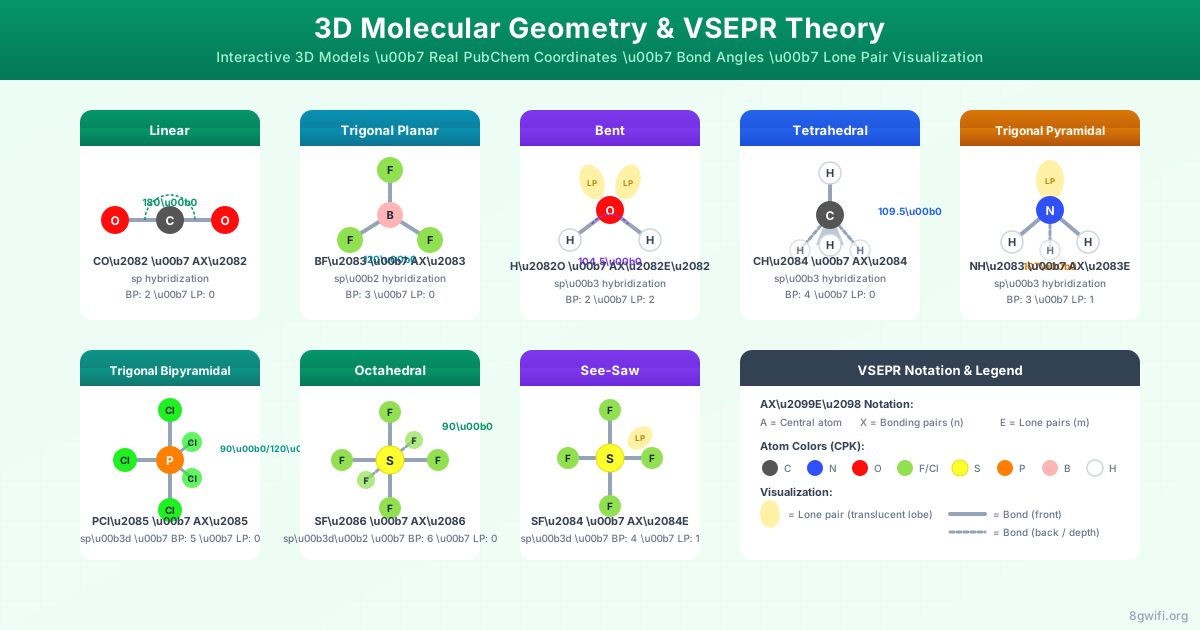
Quick reference cards:
● Linear (AX₂)
180° • sp • CO₂, BeCl₂, HCN
● Trigonal Planar (AX₃)
120° • sp² • BF₃, SO₃, AlCl₃
● Tetrahedral (AX₄)
109.5° • sp³ • CH₄, CCl₄, SiH₄
● Bent (AX₂E / AX₂E₂)
104–120° • sp² or sp³ • H₂O, SO₂, O₃
● Trigonal Pyramidal (AX₃E)
~107° • sp³ • NH₃, PCl₃, AsH₃
● Octahedral (AX₆)
90° • sp³d² • SF₆, PF₆⁻
7 Understanding Hybridization
Hybridization describes how atomic orbitals mix to form new hybrid orbitals for bonding. The total number of electron domains (bonding + lone pairs) determines the hybridization type.
2 domains → sp
Two hybrid orbitals at 180°. Linear. Examples: CO₂, BeCl₂, HCN.
3 domains → sp²
Three hybrid orbitals at 120°. Trigonal planar. Examples: BF₃, SO₂, O₃.
4 domains → sp³
Four hybrid orbitals at 109.5°. Tetrahedral. Examples: CH₄, NH₃, H₂O.
5 domains → sp³d
Five hybrid orbitals at 90° & 120°. Trigonal bipyramidal. Examples: PCl₅, SF₄.
6 domains → sp³d²
Six hybrid orbitals at 90°. Octahedral. Examples: SF₆, XeF₄.
8 Polarity & Dipole Moments
Molecular geometry directly determines whether a molecule is polar or nonpolar. When electrons are not distributed equally, the molecule has a net dipole moment (μ = δ × d). Electronegativity differences between atoms create partial charges (δ+ and δ−).
Nonpolar
CO₂ is linear — two equal C=O dipoles point in opposite directions and cancel out. Net dipole = 0.
Polar
H₂O is bent — the two O–H dipoles point in similar directions and do not cancel. Net dipole ≠ 0.
Quick Polarity Rules
No lone pairs on central atom + all identical terminal atoms = nonpolar (e.g., CH₄, BF₃, SF₆)
Symmetric geometry can still be nonpolar even with polar bonds — dipoles cancel by symmetry (e.g., CO₂ linear, XeF₄ square planar)
Lone pairs on the central atom almost always make the molecule polar (e.g., NH₃, H₂O, SF₄)
9 Why Molecular Geometry Matters
Molecular shape determines physical and chemical properties, from boiling points to biological activity.
Drug Design
Pharmaceutical molecules must have the right 3D shape to bind to protein targets. Geometry determines whether a drug fits its receptor like a key in a lock.
Polarity & Solubility
CO₂ is linear and nonpolar (dissolves in oil), while H₂O is bent and highly polar (universal solvent). Same atoms, different geometry, different properties.
Material Science
Silicon’s tetrahedral bonding (sp³) creates the diamond cubic crystal structure that makes semiconductor chips possible.
Biological Activity
Enzyme active sites recognize substrates by their exact 3D shape. A single bond angle difference can make a molecule biologically inactive or toxic.
Frequently Asked Questions
Explore More Chemistry Tools
Practice NCERT Problems
Apply your molecular geometry knowledge to NCERT chemistry and physics problems: